
Growing a community garden and collective action
This blog post is a republication of 3 short texts written by Clemence Scalbert for Reconnect Magazine, issues 99 (Dec/January 2026), 100 (Feb/March 2026), and 101 (April/May).
Setting-up a garden
Community gardens enhance health, wellbeing, and community resilience. They support biodiversity, food sovereignty, and climate action. According to a recent report by the Royal Horticultural Society (RHS Space to Grow Report, 2025), 2.5 million adults in the UK have taken part in community gardening in the past three years, and 14.7 million would love to be involved. Community gardens are vital for connecting those who don’t have a garden of their own with opportunities to access nature. So, where do we start?
Often, it’s a combination of circumstances. It depends on our vision, the people around us, and the space we have – or will find. Do we dream of growing food, supporting wildlife, bringing people together, or improving our neighbourhood? Do we have access to a big or small space? Is it open or enclosed? Sunny or shaded? Already planted?
One of the most common challenges is finding a suitable space. This often involves exploring the local area – walking, cycling, looking, and talking – to identify neglected or unused sites. The majority of community gardens in the UK are on public land, though others may be on church grounds, school sites, or private land (owned by a company in town, or a farm in a village for instance).
The first step is to identify a potential space and its owner, then start a conversation with them. In time, it’s useful to have a lease in place so everyone understands the terms of use and can work together smoothly. Very often, such spaces are leased for a symbolic “peppercorn” rent of £1.
We may start with big dreams and ambitions, but in practice it takes time, and energy to establish a community growing space. Growing annual vegetables, for instance, is more demanding than creating a forest garden, planting perennial vegetables, or maintaining an orchard. It’s important to think about the time and energy available within the group, and to adapt what and how one grows accordingly. It’s also important to consider how to make our vision a reality within the resources – time, people, and land – available.
Many community gardens are run by volunteers, so it’s essential to build a strong core group of people who will take care of the space. We don’t need to be very many to start; the most important is to be motivated! It can be very helpful to present one’s ideas to the wider community – for example, at a meeting or local festival. Sharing our plans often attracts support and new participants.
A great way to gather inspiration and practical advice is to visit other local community gardens, and to chat with their members about how they operate, the challenges they face, and what they’ve learnt along the way. Meeting with the local councillor or community builder can also be valuable, as they can point us towards potential sites, landowners, and available resources to help us get started.
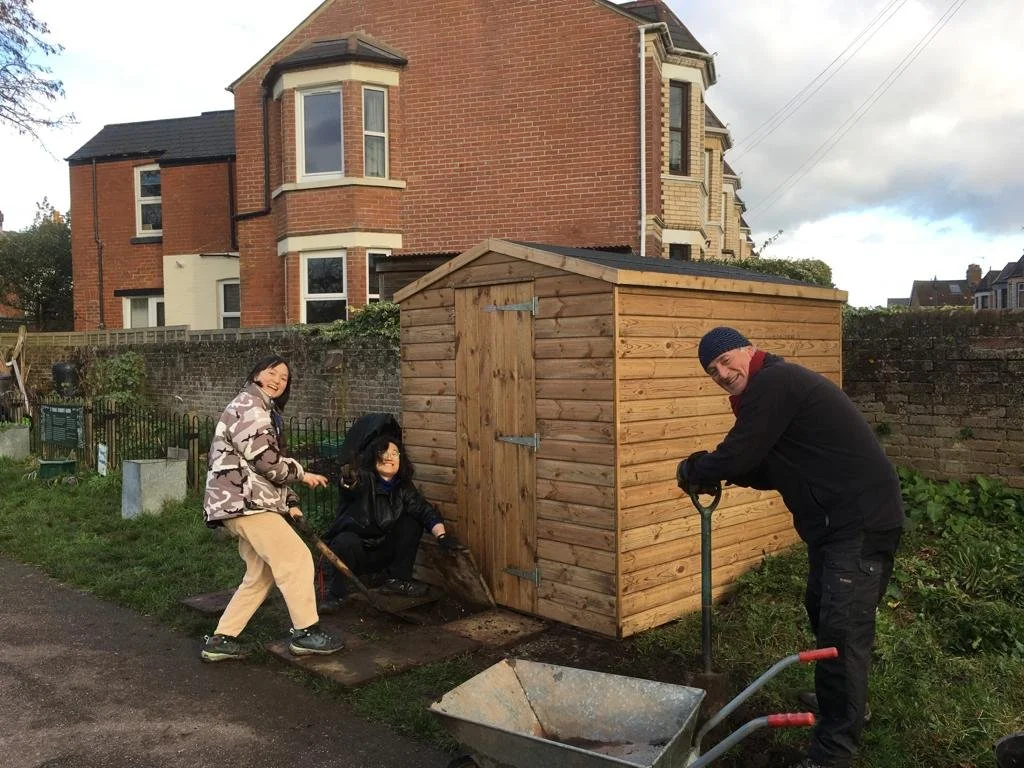
Finishing installing the shed at St Thomas Community Garden, Exeter. Credit: Clemence Scalbert
Sustaining the garden
One doesn’t need many resources to start and run a community garden, particularly if the site is relatively small and there is no paid staff - it’s another story if you wish to employ staff, but an important one (we hope to explore that in another post). Simple hand tools can be sourced from local charity shops or skips, and neighbours may happily donate some of their spares. Seeds can be sourced from local seed banks or seed swaps (for instance, in Devon, the South Brent Seed Swap, Exeter Seed Swap, or Newton Abbot Seed Library), or saved year on year in the garden. Water can be harvested from a neighbouring roof or an existing shed, and compost produced on site through a community composting scheme — another great way to get the community and local cafés and shops involved in the garden. All of these are also great ways to include recycling and repurposing in the garden.
However, some cash is needed to purchase public liability insurance or to buy equipment such as a shed, a water butt, or a polytunnel. Local councils, Devon County Council, and local councillors often have pots of money to support community group activities, such as ward grants, locality budgets, or the Growing Communities Fund. Organisations such as Devon Wildlife Trust, through its Wilder Communities programme, or Community Action Groups (CAG) Devon are also great sources of support for community gardens, providing advice, information, and signposting to funding opportunities. Such organisations can also help a group become more formalised as a community group, a charity, a coop, and organising people.
The main resource needed is indeed people, as it is people who make the garden happen. It is helpful to have regular gardening days and times to ensure that key people are there to welcome newcomers, introduce the garden and its ethos, and answer questions, provide guidance, or address any issues that may arise. Planning activities in advance and making sure everyone is aware of the jobs to be done can greatly simplify tasks on the day.
Celebrating the work of the garden and its people with an open day, harvest party, or anniversary event is a great way to inform the local community about the garden and its role, bring people together, and acknowledge the amazing work being done. These celebrations often help to raise energy levels for the future too. They are also excellent opportunities to involve new people, to develop cooperation with other local groups, and can be used for a bit of fundraising, for instance through plant or produce sales. Some national organisations run nationwide events, such as Social Farms and Gardens’ Have a Grow day. Joining in with national initiatives is a great way to connect with the wider community growing movement. The more we are, and the more connected we are, the greater our collective impact can be. In the next issue, we’ll look at the power of change of community gardening.
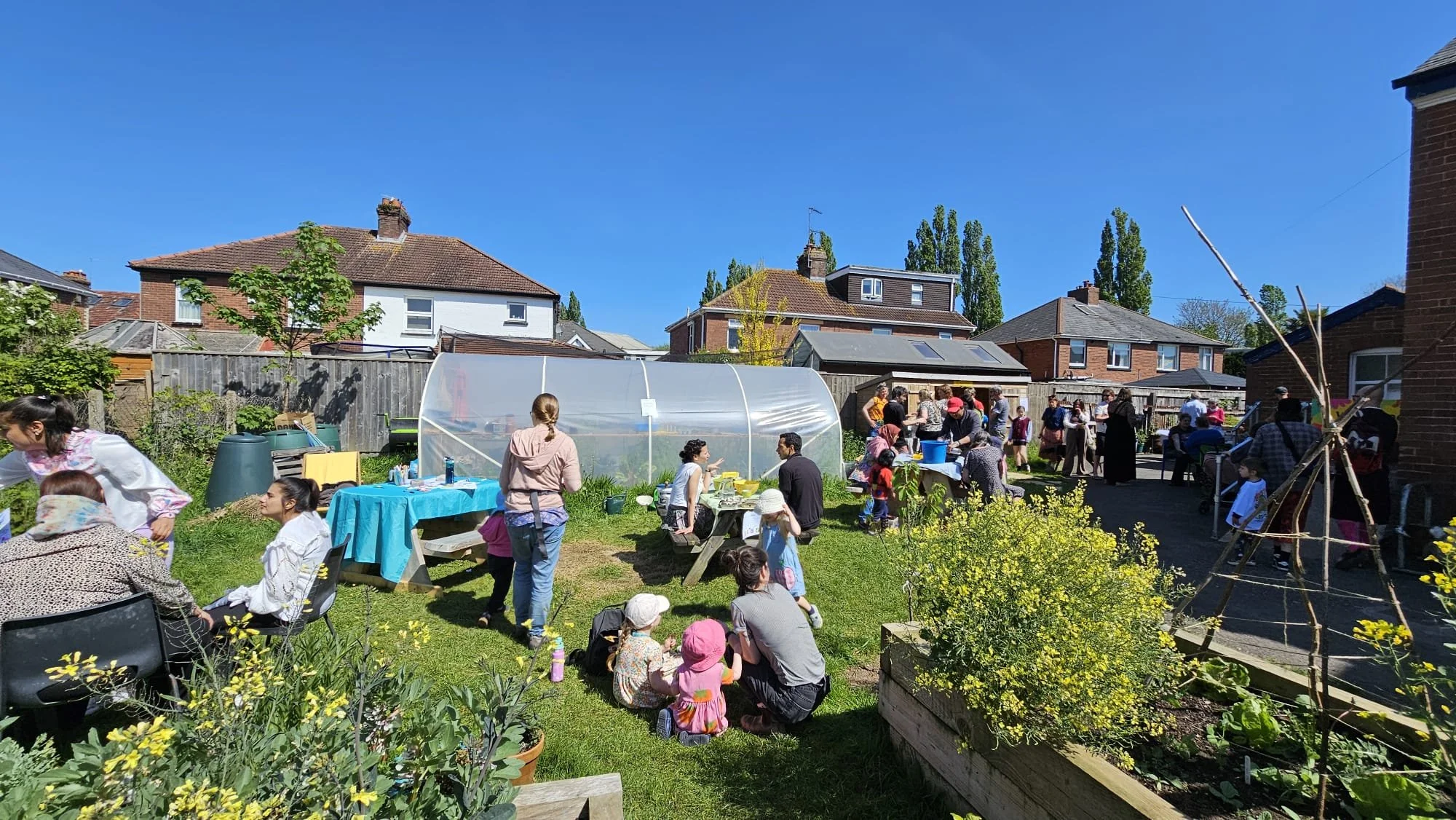
Open Day at the Alibi Garden, Exeter, April 2026. Credit: Lou Jones
Growing resistance and collective action
Community gardening and growing play many roles in our society and community: they produce food, improve mental health, combat isolation, and contribute to creating a greater sense of place and belonging. As such, don’t they seem consensual and inoffensive? One has to be wary of some side effects of such practices indeed: setting up a community garden can be part of the greenwashing strategy of a developer; a community garden can be an element contributing to the gentrification of a neighbourhood; it can also generate exclusion when it is perceived as a closed, unwelcoming club. Being aware of some of these pitfalls helps us reclaim the full resistance potential of community gardening and community growing.
Building on the local networks that shape them, community gardens and gardeners can build on their very community to mobilise, to develop connections not only with other gardens, but also with other grassroots organisations working for social and environmental justice and for land justice. Gardening a little piece of land as a collective is a way to reclaim our collective right to the land and to shape our living environment. When many collectives reclaim and garden many little pieces of land, this can be very powerful. Today the Incredible Edible Network campaigns for the Right to Grow all over the UK: a right that would facilitate community food growing public land. If all cities, towns, and parishes had a Right to grow, it would be a great first step in stressing the right of local inhabitants and communities to tend and look after their common land.
Community gardens can not produce all the food needed to feed a whole neighbourhood. Yet they are a step towards a form of local subsistence in which the community grows some of its food while developing control and gaining agency over the provenance of its food and the use of land. Community gardens can not function as isolated islands: to promote and work towards local subsistence, they have to be integrated into a larger network of agroecological food producers, other gardens, but also local farmers and growers, producing at different scales. Doing so, they can build bridges and relationships of solidarity with other, larger scale food producers and become one of the links in the transformation of the local food system. Considering staple food, community gardens can also generate or be associated to a local food coop or to a buyers group through which the community buys its staples in common, thereby bypassing supermarkets.
Working as a collective, on land cultivated in common, community gardens always need to be aware of the unequal distribution of resources and to reflect and consider its practices and their effects, often unintentional. Doing so, and working together with others in their locality, they can be one of the forces toward social and environmental justice.
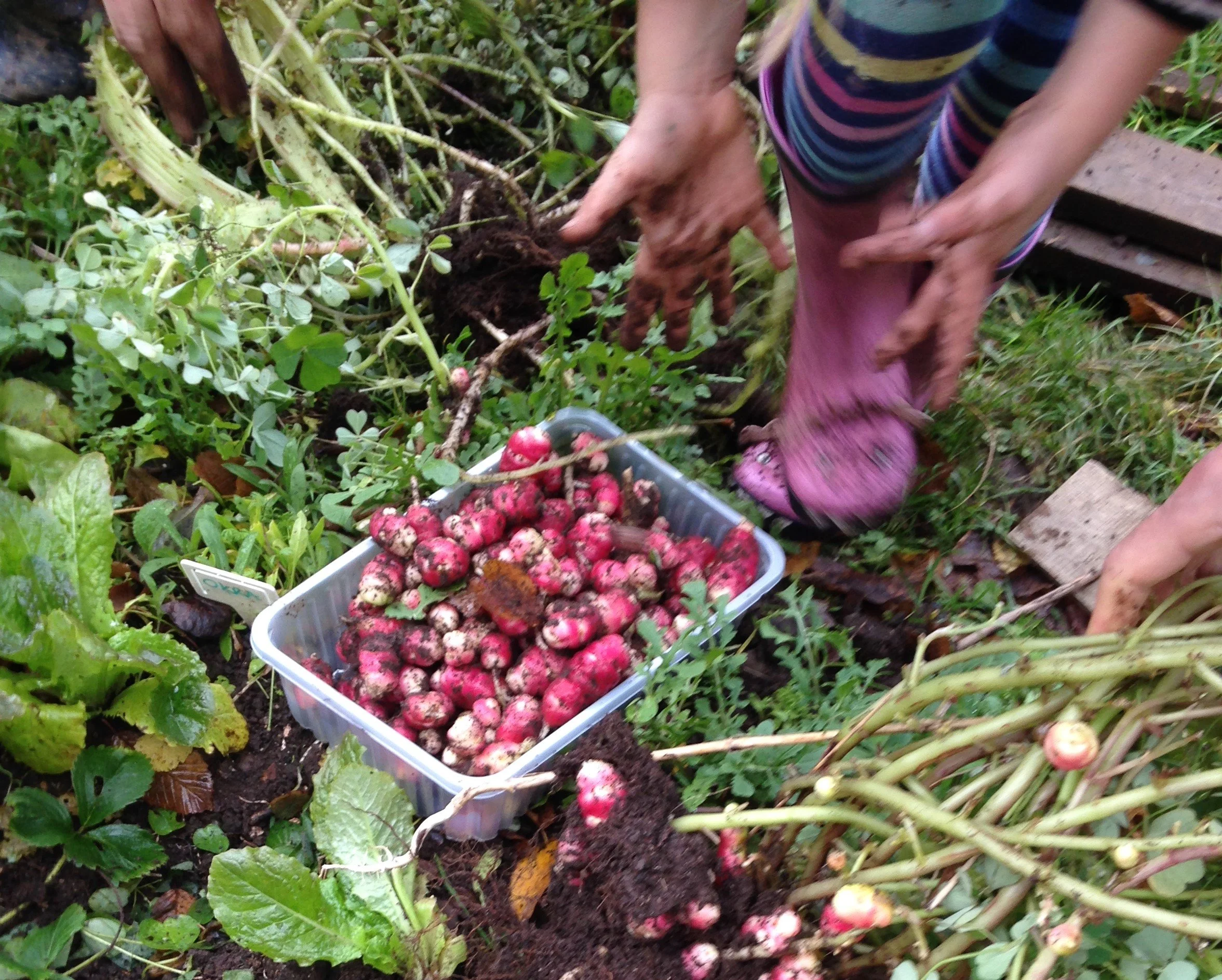
Oca Di Peru Harvest, St Thomas Community Garden, Exeter, 2021. Credit: Clemence Scalbert
